
Smoothie Pussit Explained: Finland’s Smoothie Pouches and How to Choose Reusable Ones
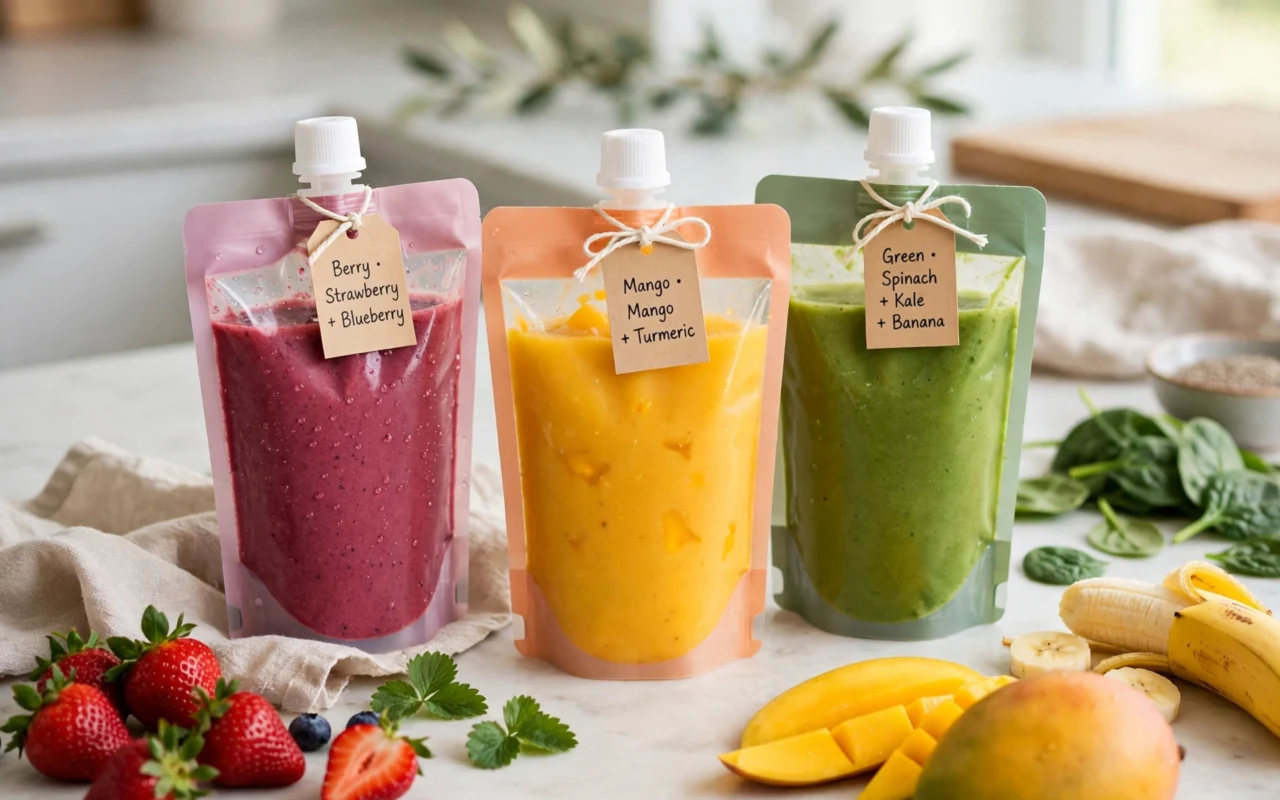
Quick answer: smoothie pussit is Finnish for “smoothie pouches” or “smoothie bags” — pussi means a bag or pouch, and pussit is its plural. The term covers three things you will meet in Finnish shops and kitchens: ready-to-drink smoothie pouches with a spout (the kind sold for children and snacks), reusable refillable pouches you fill with your own homemade smoothie, and freezer bags pre-packed with smoothie ingredients. If you are choosing pouches for your family, reusable refillable ones made from food-safe, BPA-free material — wide enough to clean properly, with a leak-proof spout and a size matched to the drinker — are the option that scores best on cost, waste and control over ingredients.
Type the phrase into a search engine outside Finland and you get a confusing pile of results: candy bags, popsicle recipes, invented smoothie brands that do not exist, and wellness pages using the word as if it were a diet programme. None of that is what a Finnish shopper means. In Finland, smoothie pussit is an everyday grocery phrase, closer to “juice boxes” than to any health movement. This guide does the honest translation work first, then turns to the practical questions: which type of pouch you actually need, what to check before buying reusable ones, how to fill, store and clean them safely, and which smoothies genuinely work in a pouch — and which clog the spout and end up in the sink.
What Does Smoothie Pussit Actually Mean?
The phrase breaks cleanly in two. Smoothie is borrowed into Finnish unchanged, the same blended fruit drink found everywhere. Pussit is the plural of pussi, an ordinary Finnish noun meaning a bag, pouch or sachet — the same word used for a bag of sweets (karkkipussi) or a tea bag’s Finnish cousins. Put together, the expression simply means “the smoothie bags.”
That plain translation matters because most English-language pages ranking for this search never make it. Some build an imaginary Helsinki smoothie brand around the word, complete with invented flavours and founding stories that no Finnish source supports. Others treat it as a mystical Nordic wellness method. A Finnish parent searching the same words is doing something far more mundane: looking for the pouches on a supermarket shelf, or for refillable ones to fill at home.
One phrase, three real-world meanings
| Meaning | What it is | Where you meet it | Filled with |
|---|---|---|---|
| Ready-made smoothie pouches | Sealed single-use pouches with a screw spout, sold chilled or ambient | Supermarkets across Finland and Europe — Finnish shelves carry local brands such as Elovena smoothie pouches alongside international baby-food brands | Commercial smoothie or purée, often fruit-and-oat blends; baby versions start from around 6 months |
| Reusable refillable pouches | Empty pouches with a wide filling opening (usually a zip base) and a spout, designed to be washed and refilled many times | Kitchen and baby shops, online stores | Your own smoothies, purées, yoghurt or porridge |
| Freezer smoothie-prep bags | Ordinary freezer bags or boxes you portion smoothie ingredients into ahead of time | Home meal-prep routines — a well-documented Finnish home habit | Raw chopped fruit, berries and greens, blended later with liquid |
All three are legitimate answers to the same search, which is why results look mixed. This article focuses mainly on the second meaning — reusable pouches — because that is where real choices and real mistakes happen, while covering ready-made pouches and prep bags where they differ.
Why Pouches at All? The Honest Case For and Against
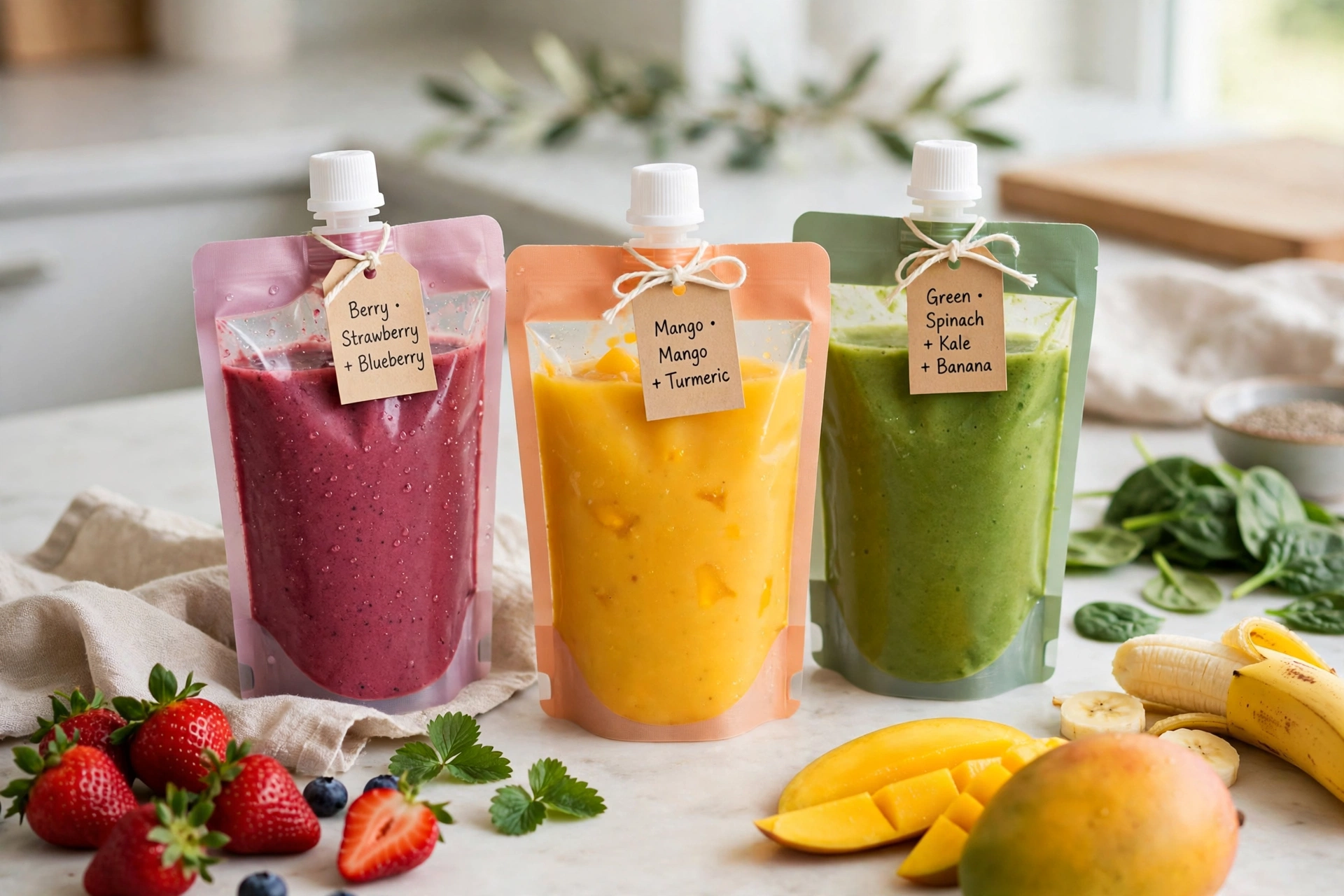
A pouch does one job a glass cannot: it travels. It is light, flexible, seals shut, and can be squeezed rather than tipped — which is why the format was perfected for baby food before adults adopted it. For small children, squeezing a pouch involves less spill risk than an open cup and lets them feed themselves earlier. For adults, a pouch fits a gym bag, a bike bottle pocket or a desk drawer, and a partly finished drink can be resealed instead of thrown away.
The honest downsides deserve equal space:
- Hygiene effort. A glass rinses in seconds. A narrow-spouted pouch has seams, a spout channel and corners where residue hides, and it must be washed and dried properly every time.
- Sucking versus chewing. Child-health professionals regularly caution that pouches should not become a child’s only way of eating fruit: chewing real pieces matters for development and teeth, and constantly sipping sweet blends — even unsweetened fruit sugars — is harder on teeth than eating at mealtimes. Treat pouches as a convenience, not a default.
- Portion blindness. A pouch disappears fast. Two pouches can equal a large smoothie before anyone notices, which cuts both ways — handy for a hungry teenager, less handy for a toddler’s appetite cues.
- Waste, if single-use. A stack of empty single-use pouches is still packaging waste, and their multi-layer construction makes most of them hard to recycle in normal household streams. More on this below.
None of this makes pouches a bad idea. It makes them a tool with conditions — exactly like the refillable bottle or the lunchbox — and the conditions are what the rest of this guide spells out.
The Main Types of Smoothie Pouch, Compared
| Type | How it works | Typical sizes | Strengths | Watch out for |
|---|---|---|---|---|
| Single-use spouted pouch (ready-made) | Buy filled, twist cap, squeeze, throw away | Commonly 90–120 g for baby/toddler snacks, around 120–200 g for older children and adults (the Elovena pouches photographed in Finnish stores are 120 g) | Zero prep, long shelf life, consistent recipes, easy for travel days | Packaging waste per serving, cost per gram adds up, fixed flavours and sweetness |
| Reusable zip-fill pouch | Fill through a wide zip opening at the base, drink from the spout | Commonly 100–200 ml for children, 250–350 ml for adult smoothies | You control ingredients and sweetness; lowest cost and waste per use over time | Must be cleaned thoroughly; zips and spouts wear with use |
| Reusable silicone pouch | Soft silicone body, often wider neck, squeeze-friendly | Similar range, often 150–330 ml | Durable, usually dishwasher-friendly, no plastic taste, stands up well to freezing | Heavier and pricier; can hold odours if stored sealed while damp |
| Freezer prep bag (ingredients) | Portion raw ingredients, freeze, blend with liquid when needed | Often 500 ml–1 litre bags for a full blender batch | Fastest weekday mornings; buys fruit in season and freezes it | Not a drinking pouch at all — the most common source of search confusion |
Sizes above are typical market ranges, not standards — always check the millilitres on the specific pack when comparing smoothie pussit options, because a “large” pouch from one maker can be smaller than a “regular” from another.
How to Choose Reusable Smoothie Pouches: A Buyer’s Checklist
Every recommendation in this checklist applies to reusable smoothie pussit you fill at home — the ready-made kind makes most of these decisions for you, for better and worse.
1. Material and food-contact safety
Look for pouches sold explicitly for food use, made from food-grade plastic or food-grade silicone, and labelled BPA-free. Within the EU, materials intended to touch food fall under food-contact rules that require them to be made so they do not transfer substances into food in harmful amounts — buying from a reputable EU retailer, with proper labelling and a named manufacturer, is the practical way to benefit from that system. Be wary of unbranded pouches with no material information at all: a pouch holds acidic fruit blends for hours, and “no information” is not the same as “food safe.” Silicone is the premium option — stable, flexible, tolerant of the freezer and dishwasher — while good multi-layer plastic pouches are lighter and cheaper but have a shorter working life.
2. Size matched to the drinker
| Who it is for | Sensible pouch size | Why |
|---|---|---|
| Babies and young toddlers (purées, first smoothies) | About 100–150 ml | Matches a small snack portion; a half-finished pouch of homemade food should not be kept long anyway |
| School-age children (lunchbox) | About 150–200 ml | A proper drink alongside lunch without dominating the meal |
| Adults (breakfast or post-workout) | About 250–350 ml | A full smoothie serving; larger than this and a bottle usually makes more sense |
3. The spout and cap — especially for children
Two details matter here. First, the spout flow: a narrower spout suits thin smoothies and older children; babies and thick blends do better with a standard wider spout. Second, the cap. Loose caps are a classic small-part hazard around toddlers, which is why caps on pouches aimed at young children are deliberately made large. Buy pouches whose caps are chunky and attached-feeling rather than tiny and fiddly, keep caps out of a small child’s mouth play, and supervise pouch snacks for the youngest children just as you would any food.
4. How it fills and how it cleans
- Wide base zip that opens fully and stands the pouch upright on the counter — narrow funnels invite spills and skipped refills.
- A spout wide enough for a bottle brush, or a design where the whole pouch turns inside-out-able / opens flat. If you cannot see inside it when washing, you cannot trust it is clean.
- Dishwasher tolerance stated by the maker, with the pouch propped open so water actually circulates.
- Freezer tolerance if you plan to freeze filled pouches, plus a write-on area for dates — a small feature that prevents most “how old is this?” accidents.
- A double zip or reinforced seal if the pouch will live in a school bag or gym bag. Leak stories, not flavour stories, are what fill negative reviews of refillable pouches of every brand.
How to Fill, Seal and Store Pouches Safely
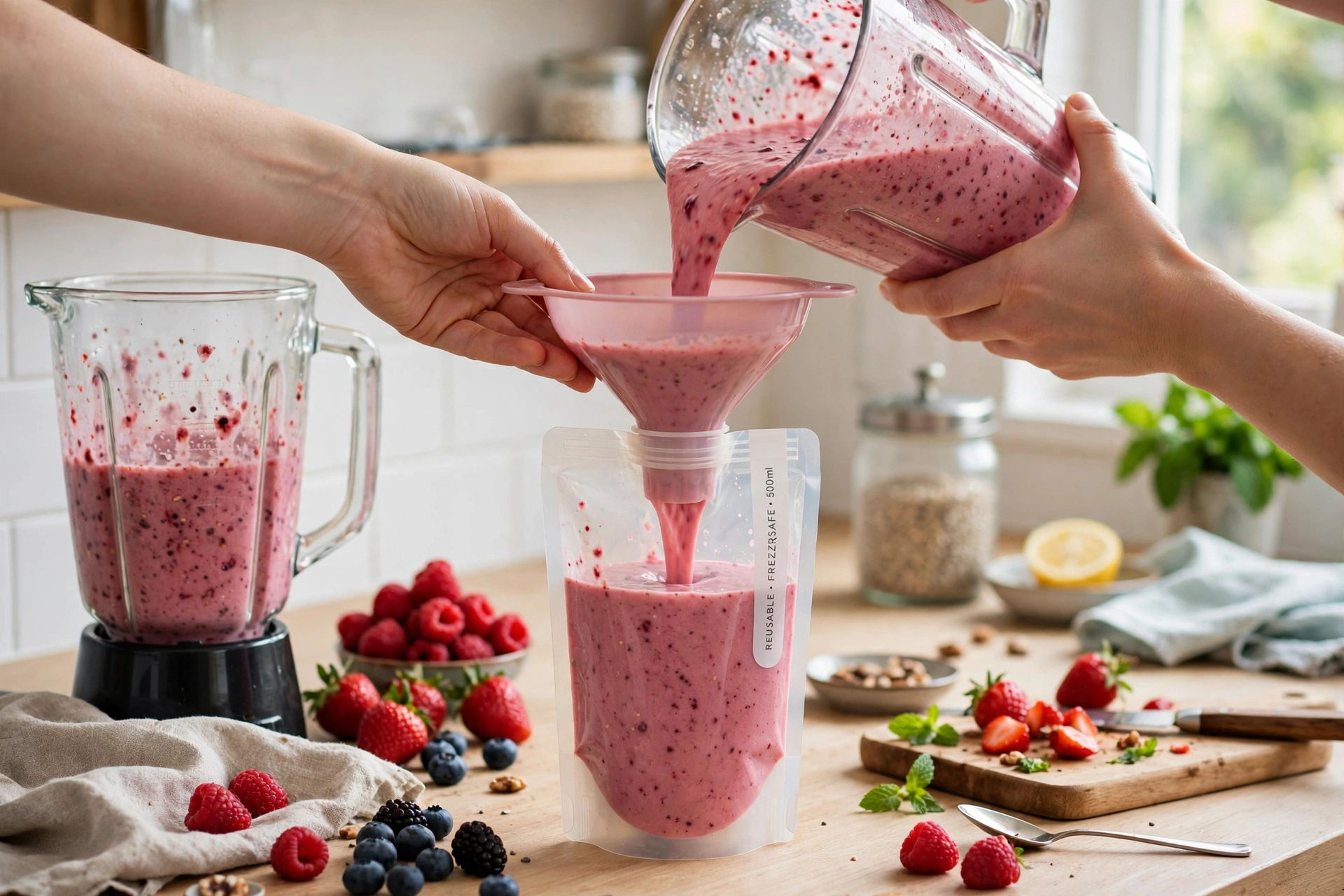
Filling smoothie pussit correctly is mostly a matter of thickness, headspace and honest labelling. The steps:
- Blend thicker than you think. Pouches reward a thick, yoghurt-like consistency. Very thin blends leak more easily, separate in the fridge and are harder for small children to control.
- Let hot blends cool first. Never fill a pouch with a hot mixture; steam pressure stresses seals and hot filling shortens the food’s safe life.
- Fill to about 80–90%. Leave headspace for sealing and, if freezing, for expansion — a completely full frozen pouch is a split pouch.
- Push air out gently before sealing, wipe the zip track clean (one smear of smoothie in the seal is the main cause of slow leaks), and close the zip fully twice.
- Label with contents and date the moment you fill, not “later.” Treat an unlabelled pouch in the fridge as an unknown and throw it out.
- Chill promptly. Homemade smoothies are fresh food. Refrigerate filled pouches right away, and put them in a lunchbox with an ice pack if they will sit for hours.
Storage times: the cautious household rules
| Where | Homemade smoothie in a pouch | Notes |
|---|---|---|
| Fridge | Best within about 24 hours | Quality and vitamin content fade with time and air; for babies, prefer freshly made or properly frozen purée over a day-old pouch |
| Freezer | Good quality for roughly 2–3 months | Freeze flat to save space; thaw in the fridge, never on the counter for hours |
| Opened / half-used | Finish the same day; do not re-chill a pouch a child has been sucking from over hours | Mouths introduce bacteria to the spout; a shop pouch label rule worth copying at home: warm a pouch in hot water if serving warm — do not microwave the pouch itself |
| Thawed | Use promptly; do not refreeze | Texture separates after thawing — a vigorous shake or squeeze-knead restores most blends |
These are deliberately cautious general rules for smoothie pussit in home kitchens, not a substitute for the instructions on a commercial product — a sealed shop-bought pouch follows its own printed dates, which always win.
Which Smoothies Actually Work in a Pouch?
Everything you load into smoothie pussit must pass the spout — literally. Blends that pour like double cream work beautifully; blends with seeds, skins, fibres or chunks jam, separate or dribble. Three rules cover most of it: blend longer than feels necessary, favour smooth-textured ingredients, and strain or avoid the worst offenders (raspberry and blackberry seeds, raw kale stems, stringy mango or celery fibres).
| Pouch-friendly blend | Base ingredients | Why it works |
|---|---|---|
| Berry-banana oat | Banana, strawberries or blueberries, rolled oats soaked in milk or oat drink, a spoon of yoghurt | Banana and oats give body; a classic Finnish-style combination (fruit-and-oat pouches are a supermarket staple) that stays thick in the fridge |
| Mango and orange | Ripe mango, orange juice, yoghurt | Naturally smooth when the mango is fully ripe; strain if your mango is fibrous |
| Green beginner | Baby spinach (not kale stems), banana, pear, apple juice | Spinach blends silk-smooth and banana/pear hide the green taste for children |
| Pear and plum porridge-style | Cooked pear and plum, fine oatmeal, cinnamon | Cooking the fruit first gives a purée texture no spout can block — a traditional weaning style |
| Post-workout adult | Milk or plant drink, banana, peanut butter, cocoa, protein source of choice | Thick, filling, and the pouch format suits gym bags; use the larger 250–350 ml size |
And a short do-not-bother list: chunky “smoothie bowl” textures, anything with chia seeds left to gel inside the pouch (it sets like glue and blocks the spout — add seeds to a glass serving instead), carbonated mixers, and very watery melon blends unless you accept separation and shake before drinking.
Hygiene and Safety for Children’s Pouches
Most pouch problems are kitchen-hygiene problems, and they concentrate where children are involved. The routine that prevents nearly all of them is boring and short:
- Wash hands, the blender jug and the pouch before filling — a pouch filled from a dirty blender is pre-contaminated, however clean the pouch was.
- For babies, use freshly prepared or properly frozen purées, serve at a sensible temperature (warm the pouch standing in hot water; do not microwave the pouch, which heats unevenly and can damage it), and discard what a baby leaves in a pouch rather than saving the sucked-from remainder.
- Inspect before every fill: splits at the seams, a perished zip, a cracked spout or any lingering sour smell are retirement signals. A reusable pouch is a food-contact item with a lifespan, not a forever object.
- Never let appearance do the safety work. A smoothie can look and smell fine while being well past its best for a small child — the date label you wrote at filling time is the only opinion that counts.
- Keep the balance: pouches for the pram, the car and the sports bag; cups, spoons and real fruit pieces at the table. That split keeps the convenience and gives children the chewing practice and mealtime rhythm they need.
Cleaning Reusable Pouches So They Stay Safe
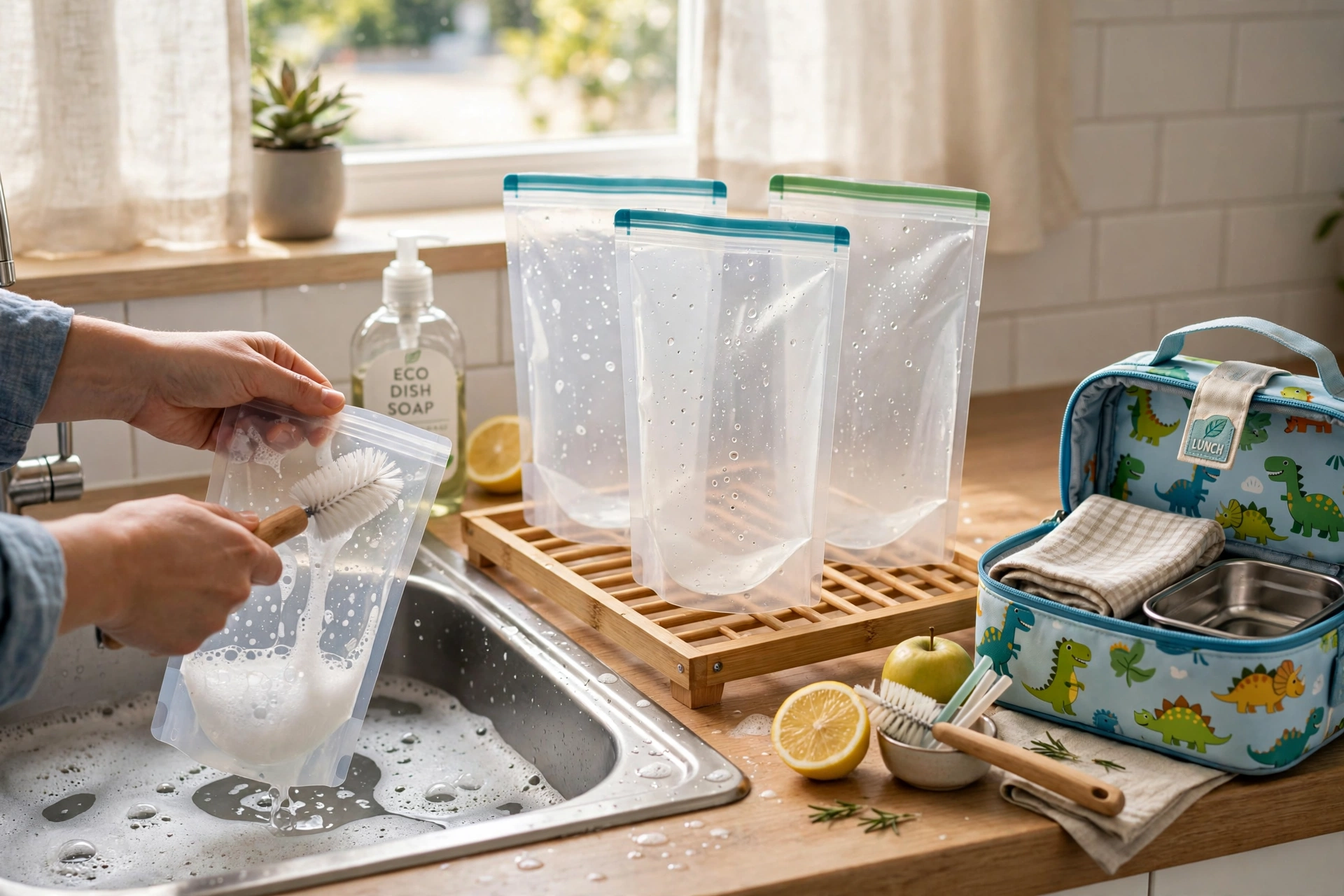
Cleaning is where reusable smoothie pussit succeed or fail as a system: the pouch that is annoying to wash is the pouch that quietly grows something in a seam.
- Rinse immediately after use — dried smoothie in a spout channel is the single hardest thing to remove later.
- Open everything: cap off, zip open, and flush water through the spout both ways.
- Brush the spout and corners with a slim bottle brush and warm soapy water; run a fingertip around the zip track to feel for residue.
- Dishwasher only if the maker allows it, propped open so the inside is actually reached — a closed pouch in a dishwasher comes out exactly as dirty as it went in, just warmer.
- Dry fully, open and upright, ideally over a bottle-drying rack or a clean peg. Storing a pouch sealed while still damp inside is how the musty, impossible-to-remove smell is manufactured.
- Deep-check weekly if in daily use: hold the pouch to the light, check seams, sniff after drying. Any pouch that fails the sniff test after a proper wash is done — replace it.
Reusable vs Single-Use: The Environmental Comparison, Honestly
| Factor | Single-use shop pouches | Reusable refillable pouches |
|---|---|---|
| Waste per serving | One multi-layer pouch every time; the plastic/aluminium laminate that keeps food fresh is difficult to recycle in ordinary household collection | Near zero per serving once in use — the pouch itself is the only eventual waste |
| Production footprint | Spread across many small items, plus food-industry filling and transport | One sturdier item; its production cost is only “repaid” after repeated use, so a reusable pouch used three times and abandoned is worse than useless |
| Washing impact | None at home | Real but modest — rinsing with your normal washing-up, not a separate hot wash per pouch, keeps it small |
| Food waste | Portions are fixed; unfinished pouches get thrown with their packaging | You fill the amount you need and can freeze homemade batches, often reducing food waste at home |
| Verdict | Best for travel days, emergencies and trying flavours | Best for daily routines — the environmental winner only when genuinely used for months |
The pattern is the same one found in most honest packaging comparisons: the reusable item wins on repetition, not on purchase. Buying the pouch is not the sustainable act; using it two hundred times is.
Buying Pouches Online Without Getting Burned
Refillable pouches are exactly the kind of simple product that attracts no-name listings with stock photos and invented specifications. Apply the checks you would use for any unfamiliar seller: a named manufacturer, a stated material, a real capacity in millilitres, and care instructions that exist. The habit of verifying what a name actually stands for before trusting it is the same one we applied when unpacking nimedes and what the name really refers to, and it scales from kitchenware to far bigger purchases — a long German trade name like kfzundlandtechnikmaaske and the specialist business behind it rewards exactly the same slow reading. A listing that cannot tell you what its pouch is made of has told you everything you need to know.
Common Mistakes and Myths
- Myth: it is a Finnish smoothie brand or diet. No such brand appears in Finnish sources. It is a common noun phrase, and pages presenting it as a wellness movement are decorating a dictionary entry — a pattern worth recognising whenever an ordinary foreign word is sold back to you as a secret, much like the inflated claims we sifted through in our explainer on onlyworkmoods com and what actually sits behind the name.
- Mistake: filling with thin, seedy or fibrous blends and blaming the pouch when the spout clogs. The spout is honest; the blend was wrong.
- Mistake: treating the fridge pouch like a shelf-stable one. A homemade filled pouch is fresh food with a day-scale life, however professional it looks sealed.
- Mistake: skipping the label. Every mystery pouch thrown away “to be safe” is a small, avoidable food-waste tax on an unlabelled fill.
- Mistake: buying the smallest, cheapest multipack first. Sizes and spouts differ enough that one test pouch of each candidate size saves money over a bargain bundle in the wrong size.
- Myth: reusable automatically means greener. Only repeated use makes it so — see the comparison table above.
Frequently Asked Questions
What does smoothie pussit mean in English?
It is Finnish for “smoothie pouches” or “smoothie bags”: pussi means a bag or pouch and pussit is the plural form. It describes ready-made smoothie pouches, reusable refillable pouches, and — in home meal prep — bags of smoothie ingredients ready for the blender.
Are reusable smoothie pouches worth it?
For anyone making smoothies or purées weekly, yes: the per-use cost drops quickly below single-use pouches, you control the ingredients and sweetness, and waste per serving falls to almost nothing. For occasional use, ready-made pouches are simpler and the reusable set risks gathering dust.
How long does a homemade smoothie keep in a pouch?
In the fridge, plan on about 24 hours for your smoothie pussit for best quality and safety, especially for children. In the freezer, filled pouches keep good quality for roughly 2–3 months. Thaw in the fridge, use promptly, and never refreeze a thawed pouch.
Can you freeze smoothie pouches?
Yes — fill to 80–90% to leave expansion room, freeze flat, and label with the date. Thawed blends can separate; a shake or gentle knead of the pouch usually brings the texture back.
How do you clean a reusable pouch properly?
Rinse straight after use, brush the spout and corners with warm soapy water, rinse through the spout both ways, and dry the pouch fully while open and upright. A pouch stored damp and sealed will develop a musty smell that no later wash fully removes.
Are smoothie pouches good for babies?
They are convenient for travel and snacks, and commercial baby pouches are formulated for the age on the label. Health professionals advise balance rather than exclusivity: babies and toddlers also need spoon-feeding, chewing practice and mealtime drinks from a cup, and a sucked-from pouch’s leftovers should be thrown away, not saved.
What size pouch should I buy?
About 100–150 ml for babies and young toddlers, 150–200 ml for a school lunchbox, and 250–350 ml for an adult smoothie. Check the printed millilitres rather than the marketing size name, because makers size differently.
Conclusion
The search phrase sounds exotic; the reality is refreshingly ordinary. Smoothie pouches — ready-made on Finnish supermarket shelves, refillable in home kitchens, and reborn as freezer prep bags in meal-prep routines — are a simple format that solves a real problem: healthy drinks that travel. Choose food-safe materials from a maker who names them, match the size to the drinker, respect the spout when you blend, label and chill like it is fresh food (because it is), and clean the pouch as carefully as you filled it. Do those few things and the humble smoothie pussit earns its place in the drawer — not as a wellness movement, but as a well-chosen tool.



1 Comments