
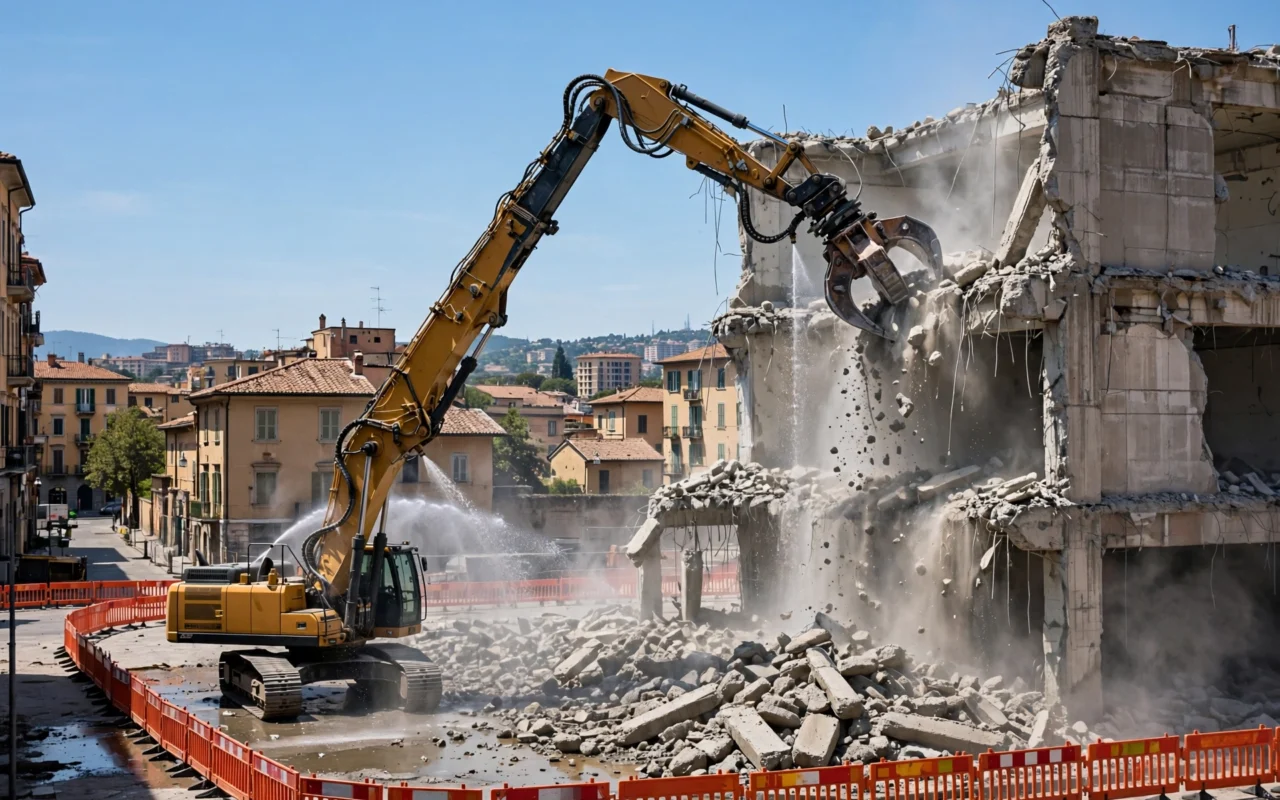
Quick answer: SOA OS23 is not software and not an operating system. It is a category in Italy’s public-works qualification system: OS23 is the specialised-works category for demolition of works (demolizione di opere), and an SOA attestation in this category is the certificate a company needs to bid for Italian public demolition contracts worth €150,000 or more. The attestation is issued by an authorised attestation body, is graded by contract value (classifications I to VIII), and lasts five years with a mandatory check in the third year. If a website tries to sell you an “SOA OS23 operating system” or a “2023 software standard” with that name, treat it as unverified — no official standard, vendor or product with that name could be confirmed in primary sources.
What SOA OS23 Actually Means
Break the term into its two halves and the confusion disappears. SOA is short for Società Organismo di Attestazione — an attestation body. These are private joint-stock companies, authorised and supervised by ANAC (Italy’s National Anti-Corruption Authority, which also oversees public procurement), whose only job is to examine construction firms and certify that they genuinely have the legal standing, money, people, equipment and track record their paperwork claims.
OS23 is one line in the official category table those bodies certify against. Italian qualification is split into general-works categories (OG) and specialised-works categories (OS) — 52 categories in total. Every OS code names a specialism: OS1 is earth works, OS21 is special structural works, and OS23 is demolizione di opere, demolition of works. So an SOA OS23 attestation simply means: “an authorised body has verified this company for demolition work, up to a stated contract value.”
The rules sit in Italy’s Public Contracts Code, Legislative Decree 36/2023 — specifically Annex II.12, which governs the qualification system for works executors. That annex replaced the older rules in Presidential Decree 207/2010, whose Annex A is still quoted by many older guides. The framework’s logic is simple: for public works of €150,000 or more, the attestation is a necessary and sufficient condition to prove a bidder’s technical and financial capacity. Contracting authorities are not allowed to demand a different proof instead.
The Other “Meaning” You Will Find Online — and Why to Be Careful
Search this term and you will quickly meet a second, completely different story: page after page describing a futuristic software architecture, sometimes called “Service-Oriented Architecture Operating System 23” or “Open Standard 2023,” complete with service meshes, event brokers and AI orchestration. Before you repeat any of that, it is worth checking it the way an auditor would.
| Claim made by software-style pages | What verification shows |
|---|---|
| It is an official open standard published in 2023 | No standards body (ISO, OASIS, The Open Group, W3C) publishes a standard with this name. None of the pages promoting it link to a specification document. |
| It is an operating system or commercial platform | No vendor, product page, documentation, download, release note or version history can be found for it. |
| Named organisations use or endorse it | The “case studies” on those pages name no verifiable company, deployment or date. |
| The demolition meaning is the obscure one | The opposite is true in primary sources: the category appears in the Italian Public Contracts Code, in ANAC-supervised lists, and in real tender notices published by Italian municipalities. |
The honest conclusion: the software story reads like content generated to fill a search trend, echoing itself from site to site. The underlying ideas it describes — microservices, event-driven design, API gateways — are real architectural patterns, but they are not a standard called by this name, and no evidence supports treating them as one. This guide therefore covers the documented, legally defined meaning, and flags the software version as unverified wherever it matters.
How Italy’s SOA Qualification System Works
Italy runs one of Europe’s most formal contractor pre-qualification systems, and understanding its shape explains why a category code carries so much weight in tenders.
- One certificate, many categories. A company is not “SOA certified” in general. It is qualified category by category (for example OG1 for civil and industrial buildings, OS23 for demolition), and within each category it receives a classification (classifica) that caps the value of work it can take on.
- Independent attestation bodies. Certificates are issued by SOA companies authorised by ANAC. By law an attestation body must be a joint-stock company with at least €1,000,000 of paid-up capital, must have attestation as its exclusive business, and is forbidden from selling any other service to the firms it certifies — a structural guard against conflicts of interest.
- Public registers. ANAC keeps the official list of authorised attestation bodies and publishes lists of qualified economic operators, so a contracting authority — or anyone — can check who holds what.
- Verification, not self-declaration. The attestation body must check the truthfulness and substance of the documents a company submits, and the continued possession of the requirements. ANAC supervises the bodies, carries out spot checks on issued certificates, and can order a certificate suspended or cancelled.
- A regulated fee. What a company pays is not a free-market price: the tariff is calculated by formula from the number of categories and the overall classification amount, under tables attached to the Code. The calculated amount is a minimum, no body may charge more than double it, stable consortia receive a 50% reduction and small firms (up to classification II) a 20% reduction.
Demolition sits inside this system because it is high-risk work: structures come down near people, traffic and neighbouring buildings, often with asbestos, contaminated material or unstable structures involved. Pre-qualification is how the Italian state makes bidders prove competence before price is ever discussed — and it is the system SOA OS23 belongs to.

What Work Does SOA OS23 Cover?
The category’s official subject is the demolition of works, and tender practice shows what that means on the ground:
- Total demolition of buildings and civil or industrial structures, by mechanical, manual or controlled explosive methods.
- Partial and selective demolition — taking down part of a structure while the rest stays standing and in use, including strip-out and separation of materials for recycling.
- Structural dismantling of reinforced concrete, steel and mixed structures, including industrial plants and infrastructure.
- Removal of the demolished material — moving elements away from the work area and loading them for transport, which tender notices regularly list inside the category’s scope.
Just as important is what OS23 does not cover on its own. A demolition contract often bundles neighbouring work, and each bundle needs its own category:
| Category | Covers | Why it appears next to OS23 |
|---|---|---|
| OS1 | Earth works | Excavation and ground movement after a structure comes down |
| OG1 | Civil and industrial buildings | Rebuilding on the cleared site, often in the same contract |
| OG12 | Environmental remediation and protection works and plants | Decontamination where demolished material or soil is polluted |
| OS21 | Special structural works | Shoring, underpinning and structural interventions around a demolition |
In a tender notice each category is marked as prevalente (the main one) or scorporabile (separable), with its own value and required classification — which is why reading the category table of a notice matters more than reading its headline.
The Classification Ladder: How Much Work Can You Bid For?
Qualification in the demolition category comes in ten amount classifications. The ladder is fixed by Annex II.12 of the Public Contracts Code and is identical across all 52 categories:
| Classification | Qualifies for works up to |
|---|---|
| I | €258,000 |
| II | €516,000 |
| III | €1,033,000 |
| III-bis | €1,500,000 |
| IV | €2,582,000 |
| IV-bis | €3,500,000 |
| V | €5,165,000 |
| VI | €10,329,000 |
| VII | €15,494,000 |
| VIII | Over €15,494,000 (unlimited) |
Three details of this table are routinely misunderstood:
- The one-fifth headroom. A classification qualifies a firm to compete for works up to its amount increased by one fifth (20%). A classification II firm (€516,000) can therefore bid on a contract worth up to about €619,000.
- Classification VIII has a conventional value. Although it is “unlimited,” the Code fixes its conventional amount at €20,658,000 for requirement calculations.
- Very large tenders add a turnover test. For a tender above €20,658,000, even a classification VIII firm must show works turnover in the previous five years of at least 2.5 times the tender amount.
Who Needs This Attestation — and Who Does Not
| Situation | Attestation needed? |
|---|---|
| Bidding, as main contractor, on an Italian public demolition contract of €150,000 or more | Yes — in the demolition category, at an adequate classification |
| Public works contract below €150,000 | The qualification system in Annex II.12 applies from €150,000 upwards; smaller contracts follow the Code’s lighter rules |
| Purely private demolition job | No — the attestation is a public-procurement instrument, though private clients often treat it as a credibility signal |
| Joining a temporary grouping (RTI) or consortium on a public tender | Each member must be qualified for its share; the grouping rules require members to hold classification of at least one fifth of the tender amount |
| Company established in another EU state | Qualification is not mandatory in the same way; under Annex II.12 such operators prove, tender by tender, equivalent requirements with documentation from their own country |
The Requirements an Attestation Body Actually Checks
An SOA OS23 application is an evidence exercise. The body examines four families of requirements, and weak paperwork in any one of them stalls the file:
1. General and legal standing
The company and its directors must be free of the disqualifying situations the Code lists — no relevant criminal convictions, no anti-mafia prevention measures, no prohibition on contracting with the public administration, and compliance with tax, social-security and workplace-safety obligations. Contribution regularity is evidenced through the DURC document.
2. Economic and financial capacity
Balance sheets and works turnover are reviewed to show the firm is sized for the classification it requests. The classification is meant to be commensurate with demonstrated economic capacity — a firm cannot simply apply for the top of the ladder.
3. Technical capacity in the category
This is the heart of a demolition application: proof of works actually executed in the category during the reference period, documented with work-execution certificates (CEL) issued by the clients who commissioned them. The assessment weighs the total value of category works and whether the firm has completed individual jobs of a size proportionate to the classification requested — one substantial job, or a combination of jobs, must anchor the claim. Private works count too, when properly certified.
4. Organisation: people, equipment and quality system
The firm must show a real operating structure: a technical director, adequate technical and professional staff, and ownership (or similarly stable availability) of the equipment its declared activity requires. For classifications above II there is an additional hard rule — the company must hold a certified quality system compliant with the UNI EN ISO 9000 series, and the attestation body records and monitors that certification.
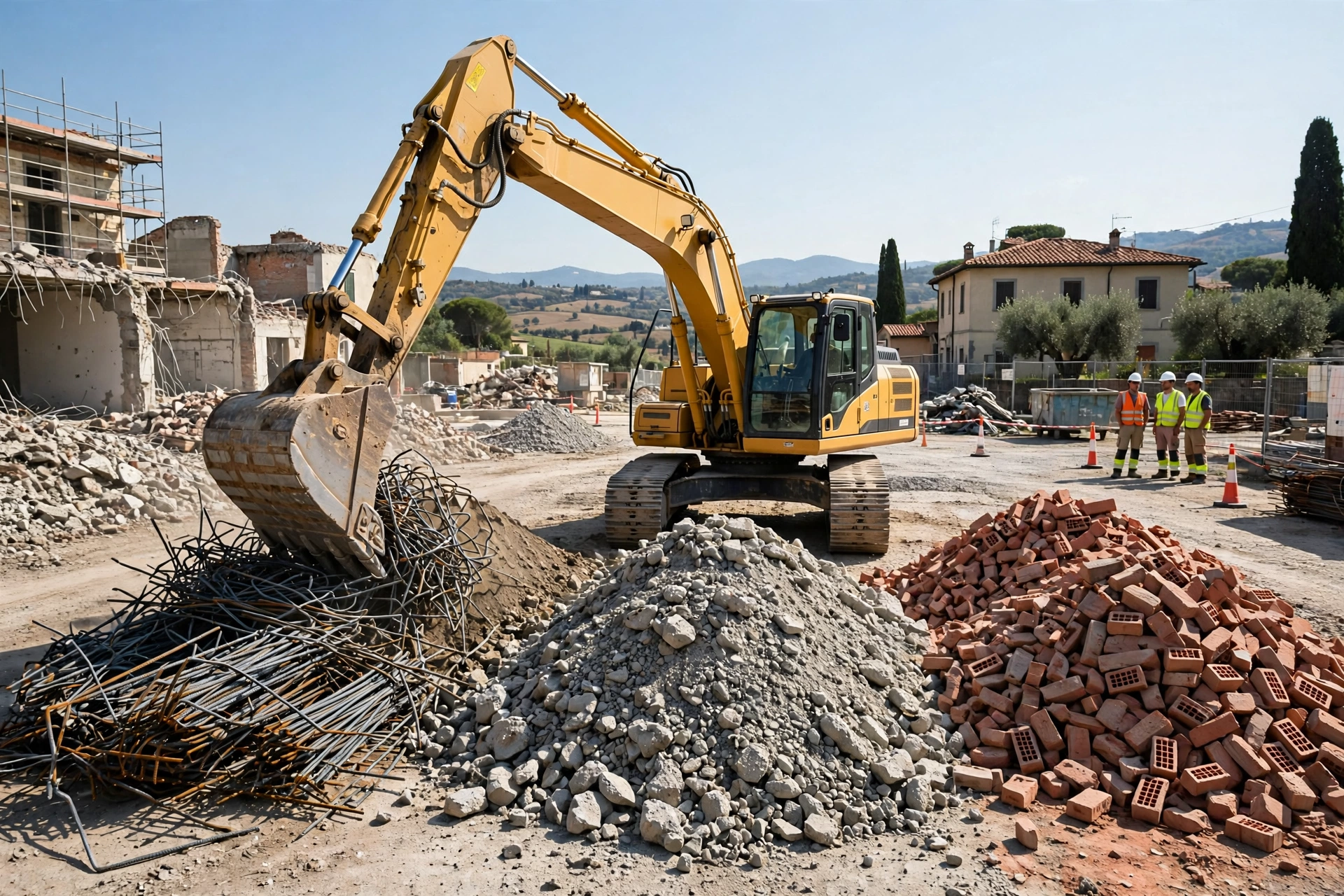
Step by Step: How a Company Gets SOA OS23 Certification
- Choose an authorised attestation body. Pick only from ANAC’s official list of authorised SOA companies. Bodies are legally barred from also consulting for you, so any “certification plus consultancy” package from the same group is a red flag.
- Sign the contract and pay the regulated tariff. The fee follows the official formula (categories requested × classification amounts), is a minimum consideration by law, and cannot exceed double the formula amount. It is paid before the certificate is issued.
- Build the evidence file. Company registration and legal-standing documents, balance sheets, DURC, quality certification (if required for the classification), staff and equipment records, and — decisively — the CEL certificates for demolition works already executed.
- Undergo verification. The body checks the truthfulness and substance of declarations, cross-checking data against sources such as the chamber of commerce database. Gaps come back as requests for integration, which is where most timelines stretch.
- Receive the attestation. The certificate states each category and classification granted. The body transmits it to ANAC, which feeds the public lists of qualified operators.
- Keep it alive. The attestation lasts five years, but validity must be confirmed at the three-year mark through an interim verification of continued requirements. Losing a requirement mid-life — a lapsed quality certificate, for example — can trigger suspension procedures, so the file is a living obligation, not a one-off purchase.
On timing, be sceptical of any page that promises a fixed number of days. The regulated steps are quick to describe and slow to evidence: in practice the work is measured in weeks of verification on top of however long a firm needs to assemble certificates from past clients. Companies that keep CEL and accounting records continuously file-ready move fastest.
Reading OS23 in a Real Tender Notice
The fastest way to understand the category is to see it working in genuine notices — both of these are real Italian municipal tenders:
- Settimo Torinese (school redevelopment). The notice for rebuilding the Martiri della Libertà school area lists the demolition of the existing school as category OS23, classification II, marked as the prevalent category at €459,275.91 — about 89% of the contract — with earth works (OS1, classification I) as the separable remainder. It also states that, because OS23 is the prevalent category, a bidder cannot use subcontracting to make up the qualification for it.
- Faenza (civil-protection centre). A negotiated procedure for completing a provincial civil-protection centre required the demolition of an existing warehouse as OS23, classification I, at €166,799.32 (46.38% of the works, prevalent category), alongside OG1 building work and OG12 environmental work under the Code’s lighter bands.
Three habits will keep you out of trouble when you read any such notice: check which category is prevalente (qualification strategies differ for it), check that your classification — with its one-fifth headroom — actually reaches the category amount, and check whether the notice restricts using subcontracting or groupings to cover a category you lack.
How to Verify a Company’s Attestation Before You Hire or Partner
- Ask for the certificate itself, not a logo. A genuine attestation names the issuing body, lists every category and classification, and shows its issue and expiry dates.
- Match the category and the number. Demolition at classification II is not demolition at classification V. Confirm the classification reaches the value of your contract (remember the 20% headroom).
- Check the dates. Five-year validity, with the three-year interim verification confirmed. An attestation past its third year without that verification is not in order.
- Cross-check against ANAC. ANAC publishes the list of authorised attestation bodies and the lists of qualified operators. If the issuing body is not on ANAC’s list, the document is worthless.
- Watch for scope creep. The certificate proves capacity for public-works qualification; it is not a safety audit of a specific site, a demolition plan, or insurance. Serious contracts still examine those separately.
Myths and Mistakes That Cost Firms Tenders
| Myth or mistake | Reality |
|---|---|
| “It is a software standard from 2023” | Unverified. No standards body, vendor or specification supports that story; the documented meaning is the Italian demolition category described here. |
| “Any SOA certificate lets us bid for demolition” | No. Qualification is per category and per classification; the wrong category or a low classification means exclusion. |
| “We need it for private demolition jobs too” | The legal obligation concerns public works of €150,000 or more. Private clients may value it, but it is not a licence to demolish. |
| “Classification VIII means no further checks” | Above €20,658,000 the Code adds a turnover requirement of 2.5 times the tender amount over the previous five years. |
| “Once issued, the certificate looks after itself” | Requirements must be maintained continuously, verified at year three, and renewed at year five; losing one can lead to suspension or cancellation. |
| “The fee is whatever the body quotes” | Fees follow a regulated formula: the calculated amount is a legal minimum and may not be more than doubled. |
What About Costs? An Honest Answer
Many English-language pages quote tidy price ranges for SOA OS23 certification. Treat them as unverified estimates. The only price rule in the primary legislation is the tariff formula in Annex II.12: the fee is computed from the overall classification amount and the number of categories requested, it is a minimum by law, and it is capped at twice the formula result — with a 50% reduction for stable consortia and 20% for firms qualified up to classification II. Your real cost drivers are therefore how many categories you request, how high you aim on the ladder, and how much internal (or consultant) time your evidence file needs. Any exact euro figure quoted without those inputs is marketing, not law.
Frequently Asked Questions
Is SOA OS23 an operating system I can download?
No. There is no operating system, software product or download with this name that can be verified in any official source. The term belongs to Italian public procurement: it is the demolition category of the SOA qualification system.
What does OS stand for in OS23?
Opere Specializzate — specialised works. The OS family of categories covers specialisms, as opposed to the OG family of general works. OS23’s official subject is demolizione di opere, demolition of works.
Below €150,000, can any firm bid for public demolition?
The Annex II.12 qualification system applies to works of €150,000 and above. Smaller public contracts are governed by the Code’s proportionate rules, which can still ask for demonstrated experience — but the attestation machinery described here is built around that threshold.
How long does an SOA OS23 attestation last?
Five years, provided continued possession of the requirements is verified at the three-year point. Certificates transmitted by attestation bodies feed ANAC’s public lists, which is where contracting authorities confirm status.
Can a foreign company work on Italian public demolition contracts?
Yes, through a different route: operators established in other EU states are not subject to mandatory qualification in the same way and instead demonstrate, for the individual tender, that they meet equivalent requirements with documentation valid in their own country.
Does holding the demolition category at a high classification help with private clients?
It is not legally required for private work, but it functions as third-party-verified evidence of track record, organisation and financial standing — which is why many certified firms display it, and why partners and insurers ask about it.
The Bottom Line
SOA OS23 is a small code with a precise legal meaning: verified qualification to demolish works under Italian public contracts, graded from classification I (€258,000) to VIII (unlimited), issued by ANAC-authorised bodies under Annex II.12 of Legislative Decree 36/2023. If you bid for Italian public work, it is the difference between being evaluated and being excluded. If you arrived here looking for a software product, the useful takeaway is different: the internet’s software story about this term does not survive basic verification, and the checks in this guide — find the primary source, find the register, find the document — are the same ones that expose it.
Keep Exploring Dow Magazine
- Renovating after a teardown often starts outdoors — see how a live grill demonstration breaks down real cooking performance in our Weber grill demonstration guide.
- Another term that means something more specific than it first appears: what “pravi celer” actually refers to, explained in full.
- For a change of pace, walk through the Inter Miami vs Tigres UANL timeline of how that rivalry unfolded.
Sources consulted for this guide include Annex II.12 of the Italian Public Contracts Code (Legislative Decree 36/2023), ANAC’s published framework for authorised attestation bodies and qualified operators, and live municipal tender notices from Settimo Torinese and the Unione della Romagna Faentina. Figures for classifications, thresholds and tariff rules are taken from the Code text; cost ranges quoted by third-party blogs were deliberately not relied on, as explained above.



1 Comments