
hcooch ch2 h2o Explained: The Miswritten Formula Behind Methyl Formate Hydrolysis
Quick answer: hcooch ch2 h2o is not a real compound and not a correct chemical formula. It is a miswritten shorthand that almost always points to one well-known reaction: the hydrolysis of methyl formate. The ester should be written HCOOCH3, not HCOOCH and not HCOOCH CH2. When methyl formate reacts with water, it splits into formic acid and methanol: HCOOCH3 + H2O ⇌ HCOOH + CH3OH. The single character that causes all the confusion is the subscript at the end of the ester — CH3, a methyl group with three hydrogens, has been typed or copied as CH2. Fix that one digit and the whole expression suddenly makes sense.
That short answer is enough if you only needed the equation for homework. Stay with this guide, though, and you will understand why the written form is wrong, what each fragment actually means, how the reaction works step by step under acid and under base, why it can run backwards, where these chemicals are genuinely used, and — just as important — what can hurt you if you handle them carelessly. Most pages ranking for this search simply repeat the same hydrolysis sentence and move on. They rarely explain the CH2 versus CH3 problem properly, they almost never give verified property data, and several of them invent connections to formaldehyde or to completely different named reactions. This article does the checking first, then the explaining.
What Does hcooch ch2 h2o Actually Mean?
Read literally, hcooch ch2 h2o is three fragments pushed together with spaces: an incomplete ester fragment, a two-hydrogen carbon fragment, and water. No bonds are drawn. No arrow is shown. No subscript in the ester fragment is complete. A chemist looking at it cold cannot point to a bottle on a shelf and say, “that is it,” because no single substance matches the string.
That is not a failure on your part if you searched for it. Search engines, class notes, copied worksheets and low-quality blogs have circulated the string for years, usually as a label for methyl formate plus water. Over time, the label started to look like a formula in its own right. It is not. It is a clue — and the clue leads to a real, textbook reaction.
The three fragments, decoded honestly
| Fragment as typed | What it most likely intends | What it literally is | Why it matters |
|---|---|---|---|
| HCOOCH | The start of methyl formate, HCOOCH3 | An unfinished formate ester fragment — the final group is cut off | Without the last carbon group, the molecule is incomplete and cannot exist as written |
| CH2 | Probably a mistyped CH3 (methyl group) | A methylene unit, –CH2–, which normally sits inside a chain with two bonds to neighbours | CH2 and CH3 differ by one hydrogen and one bond — chemically, that is a different group |
| H2O | Water, the hydrolysis reactant | Water — reactant, solvent and, in the acid pathway, a proton shuttle | Water is not decoration here; it is the molecule that does the splitting |
Understanding hcooch ch2 h2o therefore starts with a correction, not a definition. Once the correction is made, everything else — the equation, the mechanism, the products, the safety notes — falls into place.
CH2 vs CH3: The One-Hydrogen Difference That Changes Everything
This is the section most competing pages rush past, so let us slow down. Carbon forms four bonds. How a carbon group is written tells you how many of those bonds are already used and how many are left to connect to the rest of the molecule.
- –CH3, a methyl group: the carbon uses three bonds for hydrogen and has exactly one bond left. That one bond attaches it to something else — in methyl formate, to an oxygen atom. A methyl group is a neat, finished end to a molecule.
- –CH2–, a methylene group: the carbon uses two bonds for hydrogen and has two bonds left. It belongs in the middle of a chain, holding hands on both sides. Written at the end of a formula with nothing after it, one bond is left dangling — which real, stable molecules do not do.
- :CH2, methylene carbene: a genuinely existing but extremely reactive, short-lived species made only under special conditions. It is not sitting in a school lab bottle, and it is not what this search is about.
So when a worksheet or website writes the ester as if it ended in CH2, it is either copying an error or compressing the notation so aggressively that the chemistry breaks. Methyl formate ends in –OCH3. Count the atoms in the correct condensed formula, HCOOCH3: two carbons, four hydrogens, two oxygens — C2H4O2. Try the same count with a CH2 ending and you get C2H3O2 with an unsatisfied bond. Nature does not file that under “close enough.”
There is a useful habit to take away from this: whenever a formula looks odd, count atoms and count bonds before you memorise anything. That ten-second check catches a surprising share of errors online — the same checking habit, incidentally, that helps when an unfamiliar product name or technical term turns up in a search and you need to work out whether anything real sits behind it, a problem we walked through in our guide to wepbound and how to verify an unknown name before trusting it.
The Correct Reaction: Methyl Formate + Water
With the notation fixed, the reaction behind hcooch ch2 h2o can be written properly for the first time:
HCOOCH3 + H2O ⇌ HCOOH + CH3OH
Methyl formate + water ⇌ formic acid + methanol
Check the balance, because a balanced equation is the first test any claimed reaction must pass. Left side: C2 H6 O3 (C2H4O2 from the ester plus H2O). Right side: formic acid, CH2O2, plus methanol, CH4O, gives C2 H6 O3. Atoms in equal atoms out. The double arrow matters too: under acid conditions this reaction is an equilibrium, a point we return to below.
Meet the four substances
| Substance | Formula | Role in the reaction | One useful fact |
|---|---|---|---|
| Methyl formate (methyl methanoate) | HCOOCH3 / C2H4O2 | Ester reactant | The simplest carboxylate ester; made industrially from methanol and carbon monoxide |
| Water | H2O | Reactant and solvent | Supplies the –OH and –H that end up in the two products |
| Formic acid (methanoic acid) | HCOOH / CH2O2 | Carboxylic acid product | The simplest carboxylic acid; the acid ants and stinging nettles use |
| Methanol | CH3OH | Alcohol product | The simplest alcohol — useful, and seriously toxic to humans |
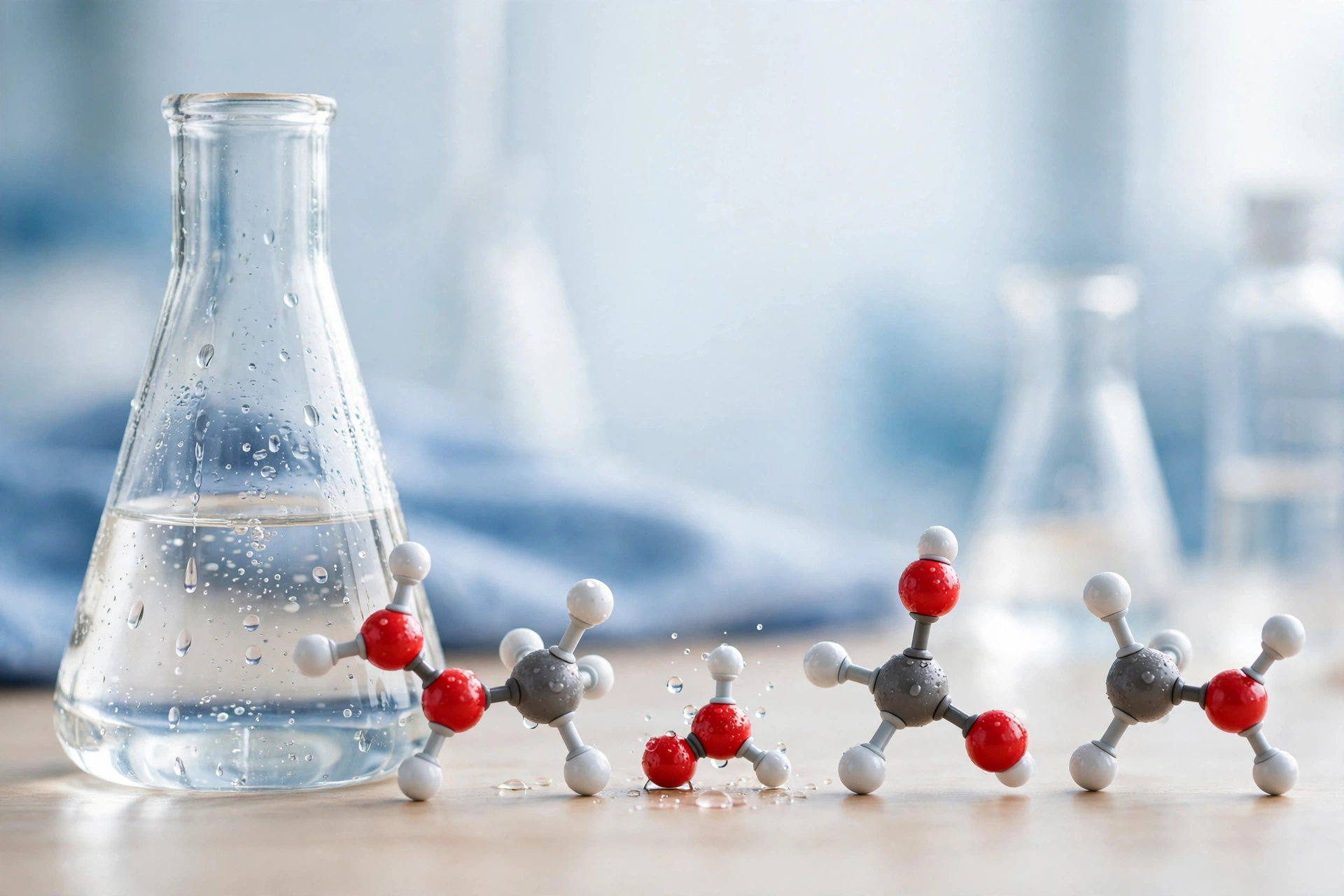
Notice what the reaction really is at its core: one bond breaks and two new ones form. The bond between the carbonyl carbon and the methoxy oxygen is cut by water. Everything else is bookkeeping. That single idea — water cutting an ester bond — is the whole of ester hydrolysis, and methyl formate is simply the smallest, clearest example of it.
What Kind of Reaction Is This? Ester Hydrolysis, Explained Plainly
Hydrolysis literally means “splitting with water.” An ester is a compound built by joining a carboxylic acid to an alcohol and removing water. Hydrolysis is that construction run in reverse: put the water back, and the ester falls apart into the acid and alcohol it was made from.
Chemists also file this reaction under a broader family name: nucleophilic acyl substitution. That phrase sounds heavy, but it breaks into friendly pieces. “Acyl” is the carbonyl-containing part of the ester. “Nucleophile” is an electron-rich attacker — here, water or hydroxide. “Substitution” means one group is swapped for another at that carbon: the methoxy group (–OCH3) leaves and a hydroxyl group (–OH) takes its place. Whenever you meet another ester — in fats, in fragrances, in biodegradable plastics, in many medicines — the same swap is available to it. Learn it once on methyl formate and you own the pattern for hundreds of compounds.
Pure water alone will hydrolyse methyl formate, but slowly. In practice the reaction is almost always helped along, either by an acid or by a base, and the choice changes both the speed and the final products. That comparison is where most exam questions — and most of the real industrial thinking — actually live.
Acid-Catalysed vs Base-Catalysed Hydrolysis
| Feature | Acid-catalysed hydrolysis | Base-promoted hydrolysis (saponification) |
|---|---|---|
| Helper added | Dilute acid, e.g. HCl or H2SO4 — a true catalyst, regenerated at the end | Hydroxide, e.g. NaOH — consumed by the reaction, so strictly a reagent, not a catalyst |
| Attacking species | A neutral water molecule, attacking a proton-activated ester | A hydroxide ion, OH–, a much stronger nucleophile |
| Immediate products | Formic acid + methanol | A formate salt (e.g. sodium formate, HCOONa) + methanol |
| Reversible? | Yes — a genuine equilibrium with esterification | Effectively no — the formate salt cannot react back with methanol to rebuild the ester |
| Why it stops or continues | Stops when forward and reverse rates match | The final acid–base step, forming the carboxylate, pulls the whole sequence forward |
| To get the free acid afterwards | Already formed — just separate it | Add acid in a second step to protonate the formate salt into formic acid |
| Typical use | Teaching, analysis, and processes where the acid product is wanted directly | Soap-making with fats, and any job where completion matters more than elegance |
The word saponification literally belongs to soap: hydrolysing fats and oils with base gives glycerol plus carboxylate salts, which are soap. Methyl formate contains no fat and makes no soap, but the mechanism and the irreversibility are identical, so chemists borrow the term for base-promoted ester hydrolysis generally. If a source tells you that base hydrolysis of the system behind hcooch ch2 h2o “produces formic acid” in one step, it has skipped a stage — base produces formate first. The acid only appears after acidification. Small distinction, exactly the kind that separates a careful answer from a copied one.
Why the base route cannot run backwards
In the acid route, every step is a fair fight: each intermediate can go forward or back, so the whole system settles into balance. In the base route, the last step is a rout. The formic acid formed in the sequence is instantly deprotonated by hydroxide or by the methoxide present, giving a formate ion. That ion is resonance-stabilised and carries a negative charge, and methanol — a weak nucleophile with no charge — cannot attack it productively. The escape door is locked. This is also why base hydrolysis is often the practical choice when a chemist needs an ester gone, completely, rather than mostly.
The Mechanism, Step by Step in Plain Language
Mechanisms frighten students because they are usually drawn as a blizzard of arrows. Stripped of the artwork, the acid-catalysed hydrolysis of methyl formate is a short story in five moves. The base version shares the middle of the story and changes the ending.
Acid-catalysed pathway
- Protonation — waking the ester up. The acid lends a proton (H+) to the carbonyl oxygen, the double-bonded O of the ester. That positive charge makes the neighbouring carbon much more attractive to attackers. Chemists say its electrophilicity increases.
- Attack by water. A water molecule uses a lone pair to form a new bond to that carbon. The flat carbonyl becomes a crowded, four-armed tetrahedral intermediate — the pivot point of the whole reaction.
- Proton shuffling. Protons hop between the oxygen atoms inside the intermediate. This quiet rearrangement matters: it turns the –OCH3 group into –O(H)CH3+, a far better leaving group, because neutral methanol can depart instead of a strongly basic methoxide ion.
- Collapse and departure. A lone pair falls back down to reform the carbonyl double bond, and methanol is pushed out. What remains is protonated formic acid.
- Deprotonation — returning the catalyst. Water removes the extra proton, giving neutral formic acid and regenerating H3O+. The acid catalyst walks away unchanged, ready to start again. That regeneration is what earns it the name catalyst.
Base-promoted pathway
- Hydroxide attacks directly. OH– is a strong nucleophile and needs no activation step; it bonds straight to the carbonyl carbon, forming a tetrahedral intermediate carrying a negative charge.
- The intermediate collapses. The carbonyl reforms and methoxide, CH3O–, is expelled.
- An acid–base step finishes the job. Methoxide is a strong base and immediately takes a proton — from the formic acid just formed, or from water — becoming methanol. The formic acid, having lost its proton, remains as formate. This is the locked door described above: the reaction cannot reverse from here.
If you are revising, hold onto one sentence: in acid, water attacks an activated ester and the catalyst is regenerated; in base, hydroxide attacks directly and the product is trapped as a salt. Almost every comparison question on this topic is that sentence wearing different clothes.

Reversibility and Equilibrium: Why the Reaction Can Run Backwards
The forward reaction has a famous twin: Fischer esterification, in which formic acid and methanol combine to make methyl formate and water — exactly the reverse journey. Under acid conditions both directions run at once, and the mixture eventually reaches equilibrium, a state where the two rates match and the overall composition stops changing even though molecules keep swapping identities.
Three practical levers move that balance, all applications of Le Châtelier’s principle:
- Use excess water and hydrolysis is favoured, because water is a reactant in the forward direction.
- Remove a product as it forms — distilling out volatile methyl formate (in esterification) or methanol (in hydrolysis) — and the system keeps replacing it, dragging the reaction forward.
- Remove water, for example with a drying agent or a Dean–Stark trap in ester synthesis, and esterification is favoured instead.
This is not academic decoration. Industrial formic acid production has historically run through methyl formate hydrolysis, and the engineering challenge is precisely this equilibrium: reactors, excess water, separation columns and methanol recycling all exist to bully a reluctant balance into giving a useful yield. Reading a formal specification and checking what it actually requires, line by line, is a skill that transfers well beyond chemistry — it is the same discipline involved in decoding a tender category, as our explainer on SOA OS23 and what the qualification code really means shows in a completely different field.
Verified Properties of Methyl Formate
Property data is where sloppy articles quietly invent numbers. The figures below are the standard reference values for methyl formate as listed by PubChem (CID 7865), cross-checked against supplier safety data sheets and the NIST Chemistry WebBook tradition of evaluated data. Where sources differ slightly — flash point is the usual example — a range is given and the disagreement is stated rather than hidden.
| Property | Methyl formate — verified value | Note |
|---|---|---|
| Molecular formula | C2H4O2 | From condensed formula HCOOCH3 |
| Molar mass | 60.05 g/mol | PubChem computed value |
| Appearance | Colourless liquid | — |
| Odour | Pleasant, ethereal (ether-like) | Do not rely on smell as a safety test — see safety section |
| Boiling point | About 31.5 °C (88.7 °F) | Remarkably low — it boils on a warm day, which drives its flammability risk |
| Melting point | About –99 to –100 °C | — |
| Density | About 0.97 g/mL at 20 °C | Slightly less dense than water |
| Flash point | Roughly –19 to –27 °C, depending on source and method | Either way: far below room temperature, so vapour can ignite in any normal room |
| Vapour pressure | About 476 mmHg (64 kPa) at 20 °C | Very volatile; vapour is heavier than air and can travel to an ignition source |
| Solubility in water | About 30 g per 100 mL at 20 °C | Appreciably soluble — and it hydrolyses in that water over time |
| CAS number | 107-31-3 | The unambiguous registry identifier — use it when checking any data sheet |
For context, its two hydrolysis products behave very differently. Formic acid (HCOOH, molar mass 46.03 g/mol) is a colourless, pungent, corrosive liquid boiling near 100.8 °C. Methanol (CH3OH, molar mass 32.04 g/mol) is a colourless liquid boiling near 64.7 °C, fully miscible with water. One reaction, three liquids, three distinct hazard profiles — which is why a single “is it safe?” question never has a single answer.
Real Uses: Methyl Formate, Formic Acid and Methanol
Uses of methyl formate
- Chemical intermediate: a building block on the way to formic acid, formamide and other formyl compounds, and historically to products such as dimethylformamide (DMF).
- Blowing agent: used to foam some insulation and polymer foams, valued because it evaporates readily and has zero ozone-depletion potential compared with older agents.
- Solvent and extraction agent: its volatility suits fast-drying applications and certain cellulose and resin processes.
- Foundry and fumigation niches: used in some foundry resin curing systems and investigated as a stored-product fumigant.
Uses of formic acid
- Agriculture: preservative and antibacterial agent in livestock feed and silage (additive E236).
- Leather and textiles: tanning, dyeing and finishing processes.
- Rubber and cleaning: coagulating latex, descaling and professional cleaning formulations.
- Energy research: studied as a liquid hydrogen carrier, because it can release hydrogen (and CO2) over suitable catalysts and is far easier to store than hydrogen gas itself.
Uses of methanol
- Feedstock: the starting material for formaldehyde, acetic acid and a long list of industrial chemicals — including, circularly, methyl formate itself.
- Fuel and fuel component: burned directly in some applications and used in biodiesel production.
- Solvent and antifreeze component: common in laboratories, windscreen wash and industrial formulations.
Notice the loop: methanol helps make methyl formate, and hydrolysing methyl formate gives methanol back. Industrial plants exploit that loop, recycling the alcohol instead of discarding it. Everyday events run on similar hidden loops of preparation and reuse — a live demonstration format, for instance, only works because fuel, equipment and timing are staged in advance, something anyone who has read about a Weber Grillvorführung live grilling demonstration will recognise in a tastier context.
Safety: The Part of hcooch ch2 h2o Nobody Should Skip
Three hazardous liquids appear in this one small reaction. Treat the table below as the minimum awareness level, and always follow the Safety Data Sheet (SDS) for the actual product in your hand — concentrations and local rules change the details.
| Chemical | Main hazards | Handling and storage essentials |
|---|---|---|
| Methyl formate | Highly flammable liquid and vapour; vapour can form explosive mixtures with air; irritates eyes and respiratory system; harmful by inhalation | Keep away from heat, sparks and flames; ground containers when transferring; store cool and well-ventilated in approved flammables storage; use in a fume hood |
| Methanol | Toxic — can cause blindness and organ damage, and can be fatal if swallowed; also toxic through skin contact and inhalation; flammable | Never ingest; treat any suspected ingestion as a medical emergency immediately; gloves and eye protection; keep containers tightly closed and clearly labelled so it is never mistaken for ethanol |
| Formic acid | Corrosive — causes severe skin burns and eye damage, especially when concentrated; vapour irritates airways | Acid-resistant gloves and goggles; add acid to water, never the reverse, when diluting; store away from bases and oxidisers; know the eyewash and shower locations before you start |
| The reaction mixture | Combines flammability, toxicity and corrosiveness; heating a volatile ester in a sealed vessel adds pressure risk | Never heat in a sealed container unless the equipment is pressure-rated for it; small scale first; no lone working with these materials |
Two warnings deserve their own sentences. First, methanol poisoning is a medical emergency: its danger comes from the body converting it to formic acid and formaldehyde, and early symptoms can look deceptively mild while damage builds. Second, a pleasant smell is not a safety feature: methyl formate’s ethereal odour is sometimes quoted as if it were reassuring, but a liquid that boils at about 31.5 °C and flashes far below room temperature deserves respect, not a sniff test. If a blog presents the chemicals behind hcooch ch2 h2o as harmless because one of them is “just water,” stop reading that blog.
Common Mistakes and Myths in Competitor Pages
- Myth: it is a single compound. No database lists a substance under this string. It is shorthand plus a typo, not a molecule.
- Myth: CH2 here means formaldehyde. Formaldehyde is CH2O — it contains oxygen. A bare CH2 in the typed string is a methylene fragment or, far more likely, a mistyped CH3. Pages that build entire reaction schemes (Eschweiler–Clarke, Cannizzaro) on the formaldehyde reading are decorating a guess.
- Myth: HCOOCH is the formula of methyl formate. It is two atoms short of one. The complete condensed formula is HCOOCH3.
- Myth: base hydrolysis gives formic acid directly. It gives a formate salt. Acidification is a separate step.
- Myth: water makes the process automatically “green.” Water is a benign reactant, but the system also involves a highly flammable ester and a toxic alcohol. Greenness is judged on the whole process — energy, separation, recycling and waste — not on one ingredient.
- Myth: precise-looking conditions must be correct. Several ranking pages state exact temperatures, pressures or rate constants with no source at all. Unreferenced precision is a style, not evidence. Check figures against PubChem, NIST or an SDS before repeating them.
- Mistake: calling the string a balanced equation. It has no arrow, no products and, as typed, the wrong atom count. The balanced equation is the one given in this article.
How to Answer Questions on This Topic (Students’ Checklist)
- Correct the formula first: write HCOOCH3, and say plainly that the original string is miswritten.
- Write the balanced equation: HCOOCH3 + H2O ⇌ HCOOH + CH3OH.
- Name the reaction type: ester hydrolysis, a nucleophilic acyl substitution.
- State the conditions you are assuming — acid or base — because the products differ (acid versus formate salt).
- If mechanism is asked, give the five acid steps or the three base steps, and mention the tetrahedral intermediate; it appears in both.
- If equilibrium is asked, invoke Le Châtelier: excess water or product removal drives hydrolysis; water removal drives esterification.
- Add one safety fact. Mark schemes reward it, and real laboratories demand it.
Frequently Asked Questions About hcooch ch2 h2o
Is hcooch ch2 h2o a real chemical?
No. As written it is not a recognised compound, formula or named reaction. It is best understood as a miswritten reference to methyl formate (HCOOCH3) reacting with water.
What is the correct formula for methyl formate?
HCOOCH3 in condensed structural form, C2H4O2 as a molecular formula, with a molar mass of 60.05 g/mol.
What are the products when methyl formate reacts with water?
Under acid conditions: formic acid (HCOOH) and methanol (CH3OH). Under base conditions: a formate salt and methanol, with formic acid available after a separate acidification step.
Why is CH2 wrong at the end of the formula?
A terminal –CH2 group would leave carbon with an unsatisfied bond. Methyl formate ends in a methyl group, –CH3, which uses its one remaining bond to attach to oxygen. One hydrogen changes the group, the atom count and the chemistry.
Is the hydrolysis of methyl formate reversible?
In acid, yes — it sits in equilibrium with Fischer esterification. In base, effectively no, because the product is trapped as a formate salt that methanol cannot attack.
Is methyl formate dangerous?
It must be treated with care: it is highly flammable, boils at about 31.5 °C, has a flash point well below room temperature, and its vapour irritates the eyes and airways. Work with it only with proper training, ventilation and ignition control, following its SDS.
Can I try this reaction at home?
No. The system involves a highly flammable ester, corrosive formic acid and methanol, which is toxic and can cause blindness or death if swallowed. This is laboratory and industrial chemistry, not a kitchen experiment.
Conclusion
The search string hcooch ch2 h2o survives because it looks like chemistry while quietly containing a mistake. Corrected, it opens the door to one of organic chemistry’s most instructive reactions: methyl formate plus water, splitting cleanly into formic acid and methanol. Remember the three moves that unlock the whole topic — fix CH2 to CH3, balance the equation, and ask whether the conditions are acidic or basic, because that choice decides the products and whether the reaction can run backwards. Add verified data instead of copied numbers, and a proper respect for three genuinely hazardous liquids, and you have not just the answer to a search query but a small, complete lesson in how chemistry should be read: carefully, sceptically, and one bond at a time.




1 Comments